

For a clearly scoped kitchen or bathroom remodel, choose a fixed-price contract; for an older home, a gutted structure, or any project with real scope unknowns, cost-plus or a capped version of it protects you better. The trade-off is simple: fixed-price buys budget certainty, cost-plus buys flexibility and transparency. Pick based on how well anyone can actually predict the scope before work starts.
TL;DR:
- Cost-plus contracts are preferable for projects with uncertain scope or hidden conditions, such as older or structurally complex homes.
- Fixed-price contracts offer budget certainty but can lead to higher costs if unexpected issues or design changes arise.
- Negotiating a cap or GMP on cost-plus helps limit financial risk while maintaining flexibility for unforeseen conditions.
- Contractors' billing transparency, including invoices and receipts, is crucial regardless of contract type to avoid hidden costs.
- Lenders and homeowners with strict budgets should generally favor fixed-price or capped arrangements over unlimited cost-plus contracts.
Table of Contents
- Fixed Price vs Cost Plus: Risk, Budget, and Transparency Compared
- What Is a Fixed-Price Contract and How Does It Work?
- What Is a Cost-Plus Contract and When Does It Pay Off?
- How Do You Decide Between Fixed Price and Cost Plus?
- Which Contract Clauses Protect You From Disputes?
- How Is the Price Actually Calculated?
- An Editorial Take on Choosing the Right Structure
- Why the "Best" Contract Depends on Who You Hire
- Sources
Fixed Price vs Cost Plus: Risk, Budget, and Transparency Compared
The two models answer the same question, "who absorbs the surprise," in opposite ways. A fixed-price contract locks in one number for a defined scope, so the builder eats cost overruns and you know your number before demolition starts. Cost-plus flips that: you reimburse actual costs plus a fee, so your final bill moves with reality, better or worse.
Here's how the two stack up on the factors that actually matter to a homeowner:
- Cost risk: Fixed-price puts overrun risk on the contractor; cost-plus puts it on you, unless a cap is negotiated.
- Handling changes: Fixed-price treats any change as a formal change order with new pricing; cost-plus absorbs changes more fluidly since you're already paying actual cost.
- Financing: Lenders and banks generally prefer the certainty of a fixed number when approving a renovation loan.
- Contractor incentive: Fixed-price rewards speed and efficient sourcing; cost-plus rewards accuracy and honest billing, since there's no upside to cutting corners.
- Documentation: Fixed-price needs a detailed scope document upfront; cost-plus needs ongoing invoices, receipts, and timesheets throughout.
A third option, guaranteed maximum price (GMP), caps a cost-plus arrangement so you get a ceiling on spending while keeping open-book visibility into what you're actually paying for. It's worth understanding both pure models first, because GMP borrows mechanics from each. The sections below cover exactly what to negotiate into either one.
What Is a Fixed-Price Contract and How Does It Work?
A fixed-price, or lump-sum, contract sets one number for a defined scope of work before the first hammer swings. Some variants add nuance: fixed-price incentive contracts share savings if the job comes in under budget, and economic price adjustment clauses let the number move only with documented material cost spikes, like a sudden jump in lumber or copper pricing.
The upside is real. You get a number your bank can underwrite, you don't need to babysit invoices, and the contractor carries the accountability for staying inside their own estimate. The downside shows up the moment something changes: a hidden plumbing issue, a design tweak, an appliance upgrade. Each one becomes a change order, usually priced at a premium, because the contractor already built contingency into the original number to cover exactly this kind of surprise.
Before you sign anything, check the bid includes:
- A line-item scope of work, not a vague paragraph
- Named allowances for finishes (tile, fixtures, cabinetry) with dollar caps
- Explicit exclusions, so you know what's not covered
- A schedule with milestones tied to payment
- A defined change-order pricing method
Pro Tip: A fixed-price bid with no allowances listed is a red flag. It means either the contractor hasn't priced selections yet, or they're leaving room to upsell you later.
What Is a Cost-Plus Contract and When Does It Pay Off?
Cost-plus reimburses your contractor for actual, documented costs, then adds a fee on top, either a flat dollar amount or a percentage of total costs. The "open book" part means you should see the same invoices, supplier receipts, and labor timesheets your contractor sees.
The appeal is flexibility. You can upgrade a countertop mid-project without a contentious change-order negotiation, because you're already paying for whatever gets installed. Contractors also tend to price these jobs with a lower risk premium, since they're not gambling on an unknown scope. The catch is that your final number isn't fixed until the project is finished, which means you need to stay engaged, review invoices regularly, and trust the numbers you're being shown.
Cost-plus tends to outperform fixed-price in the following situations:
- Older homes where walls might hide outdated wiring, water damage, or asbestos
- Projects where the design is still evolving during construction
- Phased renovations where later phases depend on what's found in earlier ones
Pro Tip: Ask for a weekly or biweekly cost summary, not just a monthly invoice. Catching a $3,000 overage early is a conversation; catching it at the end is an argument.
How Do You Decide Between Fixed Price and Cost Plus?
Match your contract type to how well the scope is actually known, not to how you feel about your contractor. Run through this checklist before you sign anything:
- Is the scope fully drawn and specified? If yes, fixed-price. If you're still deciding on layout, cost-plus or GMP fits better.
- Does your budget have zero flexibility? Fixed-price gives you that ceiling. Cost-plus without a cap doesn't.
- Can you review invoices and stay involved for the project's duration? Cost-plus demands more of your time. If you can't commit to that, fixed-price removes the burden.
- Are you financing through a bank? Lenders generally want a fixed number, which pushes many financed renovations toward fixed-price or GMP.
- Is the home older than 40 years, or has it never been opened up before? Lean cost-plus or capped cost-plus, since hidden conditions are likely.
- Do you trust this specific contractor's billing practices? A trustworthy builder on cost-plus often delivers a better outcome than an unreliable one on fixed-price, regardless of which contract you sign.
Whichever you choose, negotiate specifics: ask for a cost cap if going cost-plus, ask for allowance amounts if going fixed-price, and ask for audit rights either way.
Pro Tip: If you're torn between the two, ask your contractor to price the job both ways. The gap between the numbers tells you how much uncertainty they're pricing in.
Which Contract Clauses Protect You From Disputes?
The contract language matters more than the label at the top of the page. A few clauses do most of the protective work, regardless of which pricing model you pick.
- Change-order process: Require written approval and a pre-agreed pricing formula before any change starts, not after.
- Caps and GMP carve-outs: If you negotiate a guaranteed maximum, specify what's excluded (concealed structural issues, permit delays) and how any savings under the cap get split.
- Payment structure: Tie milestone payments to inspected progress, and negotiate retainage, typically a small percentage held back until final walkthrough and punch-list completion.
- Supporting documentation: Require invoices, supplier receipts, and labor timesheets attached to every billing cycle on cost-plus jobs.
- Dispute resolution: Include a defined path, mediation before arbitration, before litigation, so a disagreement over one change order doesn't stall the entire project.
These clauses also shape your contractor's cash flow, since payment timing affects how a builder recognizes revenue on their own books, which in turn affects how aggressively they price the job.
How Is the Price Actually Calculated?
Cost-plus math is straightforward: direct costs (materials and labor) plus an allocated share of overhead, plus the agreed fee. Fixed-price math works backward from that same base, then adds a contingency buffer and allowances for anything not yet selected, all folded into one number before you ever see it.
Residential cost-plus markups commonly run 15% to 25% on top of direct costs, covering overhead, supervision, and profit. A quote below 15% is unusually lean; above 25% deserves a question about what's included.
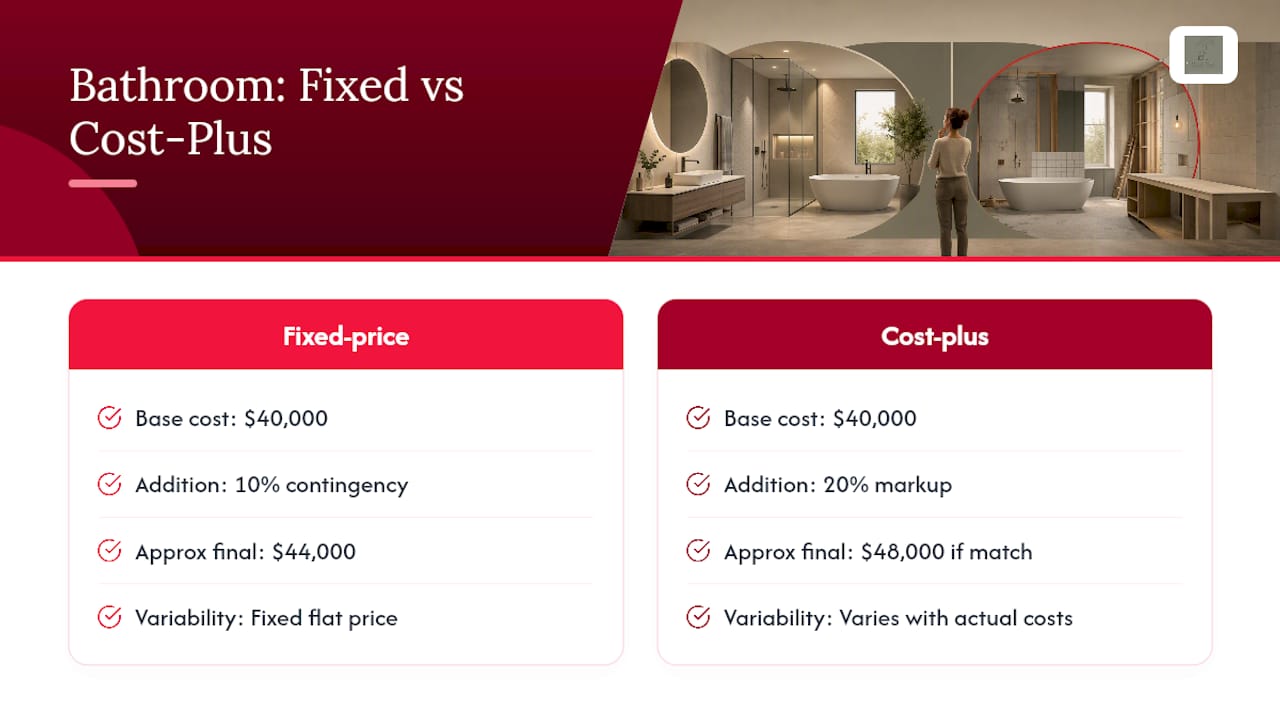
Consider two quick scenarios. A defined $40,000 bathroom remodel priced at fixed-price might carry a 10% contingency baked in, landing near $44,000 flat. That same job under cost-plus at a 20% markup on $40,000 in actual costs lands close to $48,000, but only if costs run as estimated, and could land lower if the contractor sources materials efficiently.
An Editorial Take on Choosing the Right Structure
Ariya Construction manages renovations across kitchens, bathrooms, extensions, and structural work from initial design through final handover, and the contract structure shifts with the project, not the other way around. A well-defined kitchen refresh with finalized cabinetry and fixtures might be priced fixed-price, because the scope supports it. A structural alteration on an older home, where hidden conditions may exist behind a load-bearing wall until it is opened, is often priced cost-plus or with a cap, as this helps manage risk.
Transparency shouldn't depend on which contract you sign. Ask any contractor, including Ariya Construction, for the specific documents they'll share: itemized allowances on fixed-price jobs, and invoices, receipts, and cost summaries on cost-plus jobs. A contractor who hesitates to hand those over before you sign is telling you something about what happens after you do.
If you're weighing a renovation and want a contract structure that actually matches your project's uncertainty, reach out to Ariya Construction to walk through scope, budget, and the pricing approach that fits.
Why the "Best" Contract Depends on Who You Hire
The contract type gets treated as the whole decision, and it isn't. A rock-solid fixed-price agreement with a contractor who pads every change order into a profit center will cost you more in friction than a cost-plus job with a builder who shows you the invoices without being asked. The paperwork sets the rules, but the person across the table decides how those rules get played.
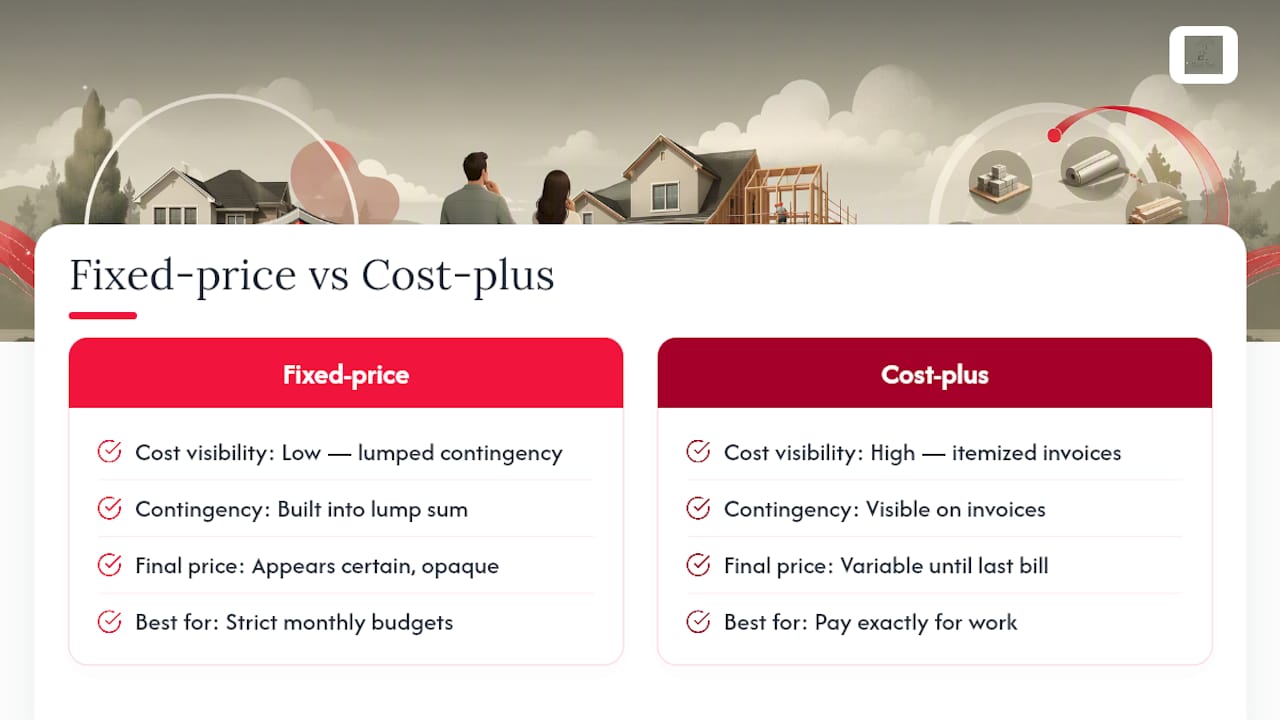
What gets underestimated most is how much fixed-price contingency pricing already assumes you'll never see. Contractors aren't guessing at random. They're pricing in the hidden condition they've hit on three other jobs this year, the material price swing they watched happen last spring, the change order they know is coming once you see the finished tile sample against the cabinet you picked six weeks ago. That contingency is invisible in a lump-sum number, which is exactly why some homeowners feel like they "overpaid" for a job that came in exactly on budget. The money didn't disappear. It moved from a line item you never saw into a total you can't itemize.
Cost-plus doesn't fix that problem so much as relocate it. You trade invisible contingency for visible variability, and whether that's a better trade depends entirely on whether you can tolerate not knowing the final number until the last invoice. Homeowners who need to sleep at night with a fixed monthly budget should stop pretending cost-plus's flexibility is worth the anxiety. Homeowners who'd rather pay for exactly what gets built, no more, no less, should stop assuming a fixed-price number is actually fixed once change orders start.
— Sarah
Sources
For deeper detail, see the cost-plus pricing breakdown from AccountingTools, the contract accounting implications from Rubino, and this guide to leveling contractor bids before comparing quotes.
- Fixed Price vs. Cost Plus: Which Is Better? | NetSuite
- Fixed Price vs. Cost Plus: Which Construction Contract Is Right for You? - MacQueen Systems
- Fixed-Price vs. Cost-Plus vs. GMP: Contract Guide
- Cost plus pricing definition — AccountingTools
- Fixed Price vs. Cost Plus Contracts: Accounting, Revenue Recognition, and Risk Explained - Rubino